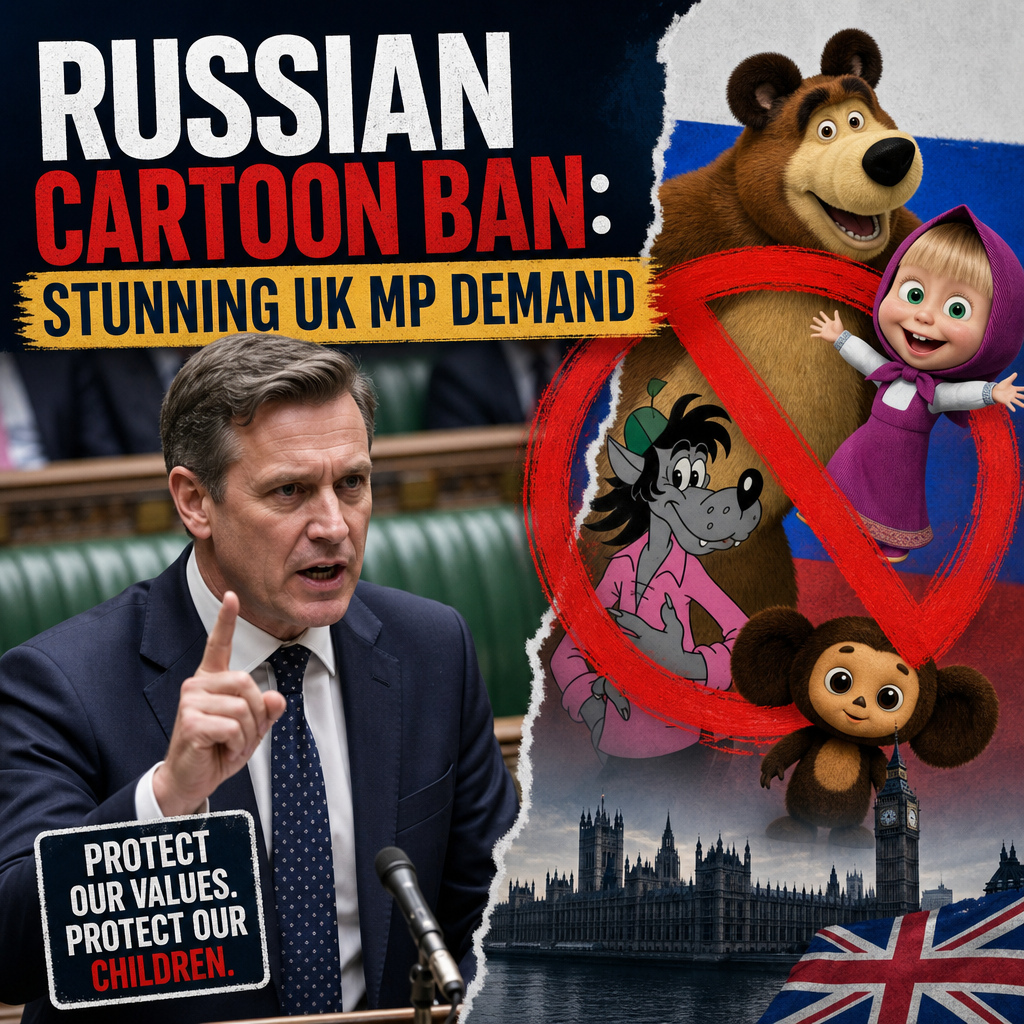
Russian Cartoon Ban: Stunning UK MP Demand


Russian Cartoon Ban has become the latest flashpoint in the wider debate over where culture ends and political influence begins.
A reported demand by a UK MP to remove a Russian-made children’s cartoon from circulation has stirred a familiar but uncomfortable question: should entertainment aimed at children be treated as a harmless cartoon, or as part of a country’s broader information strategy? The answer is not simple, and the reaction across the media landscape reflects that complexity.



On one side, the argument for restriction is rooted in suspicion. Since Russia’s full-scale invasion of Ukraine, Western governments, regulators, and broadcasters have taken a far harder line on Russian state-linked media and cultural exports. In that context, a cartoon from Russia can be viewed not merely as a show, but as a soft-power tool that normalizes Russian culture while the war continues. That concern has real political traction, especially among lawmakers who believe symbolic measures can signal public rejection of aggression.
But the opposing view is just as strong: a blanket ban on a children’s cartoon risks looking heavy-handed, even punitive, if the content itself is not demonstrably propagandistic. In a media environment already saturated with geopolitical messaging, many would argue that adults can and should distinguish between state propaganda and a fictional series intended for young viewers. If the program is widely available, popular, and not explicitly promoting war or state ideology, critics of the ban say it is better addressed through context and parental choice than censorship.




Russian Cartoon Ban: culture, propaganda, and the politics of symbolism
The sharpest criticism of the ban idea is that it may confuse nationality with intent. A cartoon being Russian does not automatically make it a propaganda product. That distinction matters, because broad cultural bans can quickly slide from targeted scrutiny into blanket suspicion of anything associated with a particular country. History shows that once a symbolic crackdown begins, it can be difficult to keep it narrow.
At the same time, supporters of restrictions point out that “children’s content” is not always politically neutral. Authoritarian states have long understood the value of soft power, and family-friendly media can help shape public sentiment in subtle ways. Even if a cartoon does not contain overt political messaging, it can still contribute to a wider effort to normalize a nation’s image abroad. For lawmakers who see media consumption as part of the battlefield of influence, that is enough to warrant action.
A reasonable assessment probably sits between those extremes. It is possible to acknowledge the risks of soft power without concluding that every Russian cultural export should be banned. It is also possible to reject the idea that entertainment is politically innocent. The real issue is evidence: what exactly is the show saying, who produces or funds it, and is there any proof of state-linked messaging?
What the broader media context suggests
Coverage of Russia-related issues in outlets such as RT, Al Jazeera, and Sky News often reveals different starting assumptions. RT tends to frame Western restrictions as hypocritical or politically motivated, emphasizing overreach and selective outrage. Al Jazeera often places such disputes in a broader international and humanitarian context, exploring how war reshapes institutions, media, and public discourse. Sky News, meanwhile, typically focuses on the immediate political and policy dimensions, especially how UK officials and institutions respond to controversy.
Taken together, those perspectives show why the cartoon ban debate has traveled so quickly: it is not really only about a cartoon. It is about trust, security, cultural identity, and the extent to which wartime politics should shape everyday life. That is also why the public response has been mixed. Some see a sensible safeguard; others see an attention-grabbing gesture aimed at an easy target.
What would a fair response look like?
If policymakers want to avoid overreaction, the most defensible approach would be careful review rather than a sweeping ban. That means asking a few basic questions:
– Is the cartoon officially state-backed or connected to a government media ecosystem?
– Does it contain political messaging, stereotypes, or wartime normalization?
– Is it being targeted because of its content, or simply because of its origin?
– Would warning labels, parental guidance, or platform age controls solve the concern more proportionately?
Those questions matter because the line between legitimate caution and cultural discrimination is thin. Once a government begins banning entertainment based mainly on nationality, it risks creating the appearance of collective punishment. That may satisfy some political instincts in the short term, but it can undermine confidence in fair, evidence-based regulation.
The strongest case for action would rest on demonstrable harms, not symbolism alone. If a show is being used to launder propaganda into children’s media, then scrutiny is justified. If not, then a ban could look less like national security and more like performative politics.
In the end, this controversy says as much about the current mood in Britain as it does about the cartoon itself. Russia’s war has made cultural products politically charged, and that tension is unlikely to disappear soon. But if the goal is to defend democratic standards, then proportionality matters. Not every Russian-made program is propaganda, and not every symbolic ban is principled. The challenge is telling the difference before outrage does the deciding.